

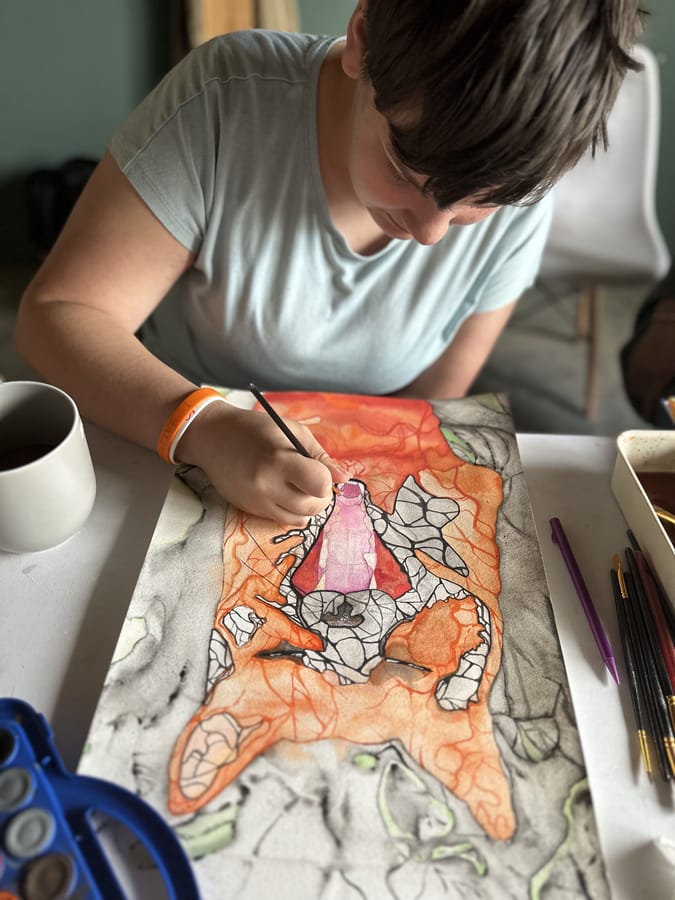
There’s something almost magical about watching a child melt into a sigh of relief the moment you put clay, paint, or even a pile of scrap cardboard into their hands.
Creativity has this uncanny ability to reach places inside us that words simply cannot.
I learned this myself as a child. I spent a huge part of my childhood in Great Ormond Street Hospital because of EDS (Ehlers-Danlos Syndrome). I didn’t have the vocabulary for loneliness, or fear, or the particular confusion of being “different.” So I poured it all into drawings instead — slightly odd creatures with big eyes and questionable proportions.
Therapists today would probably call them “expressive.” My mum called them “concerning.” I called them art.
And even now, all these years later, I see that same transformation in my students at Be Creative Cornwall. Children who arrive tense, exhausted, or completely shut down begin to soften the moment they start creating. The anxious child who hasn’t spoken all week will start quietly humming. The shut-down teenager suddenly pours life into a clay figure. The child with PDA, who panicked at every request earlier that morning, becomes totally absorbed in sculpting the world’s most dramatic dragon toenail.
It looks like magic. It feels like magic.
But here’s the best part: it’s not magic. It’s biology.
What Actually Happens Inside the Brain When We Create
When a child engages in art – or any form of creative making it something remarkable happens in the brain.
It shifts away from pure thinking mode and drops into sensory, emotional, and motor networks. The visual cortex, motor cortex, and somatosensory areas begin firing — the parts of the brain responsible for touch, movement, texture, sight, and spatial awareness. For children who spend all day being asked to sit still, listen, and process verbally, this is a profound kind of relief.
At the same time, the medial prefrontal cortex (mPFC) — a major hub for emotional regulation and self-reflection — becomes more active, while the amygdala (the brain’s emotional alarm system) begins to calm. Put more simply: art helps the brain process emotion without needing words. And for children who don’t yet have words for what they’re feeling, that matters enormously.
Research backs this up in several important ways:
- Studies consistently show a reduction in stress hormones during creative activity in both children and adults
- Evidence suggests improvements in mood and reductions in anxiety after even short creative sessions
- Creative play has been linked to neuroplasticity, the brain’s ability to rewire itself, build resilience, and recover from stress or trauma
- Hands-on sensory work (clay, texture, movement) has been shown to support nervous system regulation, particularly in children who struggle with emotional dysregulation
In simple terms: creativity helps the body shift out of fight-or-flight and into something that feels a lot more like safe.
Why This Matters So Much for Neurodivergent, Sensitive, and Burnt-Out Children
Many children spend their entire school day performing.
Masking. Navigating noise, flickering lights, confusing social rules, unpredictable transitions, and sensory overload — all while being told they’re “fine” because they’re quiet, or compliant, or managing to hold it together on the surface.
They come home like wrung-out cloth.
For these children, creativity isn’t “just a fun hobby.” It’s nervous system first aid.
When a child creates, they access something that most of their day denies them:
- Control without pressure
- Expression without judgement
- Sensory grounding without overload
- Emotional release without needing to explain themselves
For some children, a creative session is the only time in their entire week when their nervous system truly relaxes. And you can see it — the shoulders drop, the breathing slows, the face softens. The body stops scanning the room for the next threat.
Even a small amount of creative freedom; rolling clay, tearing paper, squeezing paint, building something out of nothing — can shift a child out of survival mode and back into themselves.
This is exactly why Richard Cole, co-founder of Be Creative Cornwall and a professional sculptor with over 35 years of experience, has always believed that creative making isn’t a school subject. It’s a way of thinking, communicating, and making sense of the world. In his hands, a child who has spent years being told they’re “not good at things” discovers that creativity was never about perfection in the first place. It’s about curiosity, exploration, and finding out what you’re actually capable of.
Why It Matters for Masking Children Especially
Masking is the process of suppressing or hiding neurodivergent traits in order to fit in — and it is exhausting in ways that are difficult to overstate.
Children who mask at school learn to watch others closely, copy what seems “normal,” suppress stimming or sensory reactions, and manage every interaction with careful, constant effort. They hold themselves together for six or seven hours a day. Then they get home — to the safest place they know — and fall completely apart.
This is sometimes called the “after-school restraint collapse.” And for parents who see it every single afternoon, it can be bewildering and heartbreaking.
Creative work offers something masking children rarely get: a space where there is no right way to be. No performance to sustain. No one to copy or impress. Just a material, a process, and whatever wants to come out.
It doesn’t ask them to hold anything together. And that release — even a small one — can make a profound difference to how they feel, sleep, and recover.
Why Art Matters for Parents Too
Parents often forget they have nervous systems.
We operate on fumes until the fumes run out. We absorb our children’s distress, advocate in endless meetings, research late into the night, and try to stay calm in situations that are genuinely not calm.
And yet, creativity isn’t just healing for children.
Sometimes when a parent sits beside their child and joins in, rolling clay between their palms, smudging pastel colours, scribbling something that doesn’t need to mean anything — their shoulders drop too. The breath they didn’t know they were holding finally releases.
You don’t realise how tightly you’re holding on until something lets you let go.
This understanding sits at the heart of why Emma Hartley co-founder of Be Creative Cornwall and a former NHS professional created The SEND Compass. Having navigated the education system with her own neurodivergent son, watching him slowly lose confidence in a setting that wasn’t built for him, she saw first-hand how creativity became the bridge back for him, and for her.
Parents need support, grounding, and clarity just as much as their children do. Not abstract advice, but actual tools that help regulate the nervous system and make the next step feel possible.
Creativity Isn’t a Luxury; It’s Medicine
Whether your child is autistic, has ADHD, is anxious, has a PDA profile, is burnt out, or is simply overwhelmed by the daily pressures of school and social life, creative making gives them a pathway back to themselves.
It builds:
- Confidence — through finishing things, discovering strengths, and making something real
- Emotional safety — through expression without judgement
- Self-awareness — through the quiet process of making choices and noticing what feels right
- Nervous system regulation — through sensory grounding and the calming effect of sustained, gentle focus
- Connection — to materials, to other people, and to themselves
And if all else fails, aggressively kneading a lump of clay remains one of the most underrated and affordable forms of stress relief available.
How Be Creative Cornwall Uses Creativity as a Therapeutic Tool
At Be Creative Cornwall, creativity isn’t a subject or an activity we do to fill time. It is the framework through which everything happens.
Founded by Emma Hartley and Richard Cole, which both neurodivergent themselves; Be Creative offers specialist therapeutic and creative alternative provision for children and young people with SEND, based in Wadebridge, Cornwall.
Our sessions use clay, natural materials, sensory-led making, and nature-based learning to create an environment where children who have struggled in traditional settings can finally exhale. We work with children who have:
- ADHD
- Autism
- PDA – Pathological Demand Avoidance
- Dyslexia, dyspraxia, and related learning differences
- School burnout and refusal
We also support the families around them; because a child can only thrive when the people holding them are also held.
Frequently Asked Questions
Yes. Research consistently shows that creative activity reduces stress hormones, supports emotional regulation, and can help the nervous system shift out of fight-or-flight. For neurodivergent children who spend significant energy masking or managing sensory overload, creative making offers a rare space of genuine relief and self-expression.
Many neurodivergent children mask their difficulties during the school day, holding themselves together through enormous effort. Creative activities, especially hands-on, sensory work reduce the demand on the nervous system and offer expression without performance. The calm you see during creative making is genuine nervous system regulation, not just distraction.
After-school restraint collapse describes the pattern where children hold themselves together all day at school, then release all of that stored tension once they’re home, often through meltdowns, shutdowns, tears, or explosive behaviour. It’s a sign of a child who is working incredibly hard to manage, not a child who is misbehaving. Creative activities after school can help ease this transition by giving the nervous system a safe outlet.
Art engages the sensory and motor areas of the brain while calming the amygdala, the brain’s alarm system. This means it helps children process and release emotion without needing to verbalise it. For children who struggle to identify or articulate their feelings, creative making offers an alternative route to emotional regulation that doesn’t rely on words.
Be Creative Cornwall offers specialist therapeutic and creative alternative provision — not clinical art therapy, but a creative learning environment specifically designed to support the emotional, sensory, and developmental needs of neurodivergent and SEND children. Our sessions are led by experienced practitioners in a low-pressure, relationship-first setting in Wadebridge, Cornwall.
 PDF · Approx 12 pages · Readable on phone, tablet or laptop